Dynamic Solids Process Simulation Software

Dynamic Flowsheet Simulation Software for Solids Processes

DyssolTEC enables process engineers to model time-dependent particulate behavior with DyssolPro, so teams can validate concepts before major plant decisions.

Request Consultation

Used by teams in chemicals, pharma, food, and mining. Backed by TUHH research and enterprise support from DyssolTEC.

DyssolPro Flowsheet Simulation

Typical questions DyssolPro answers

DyssolPro is not a general-purpose simulation environment. It is purpose-built for solids and particulate processes, with deep physical modeling for population balances, time-dependent particle behavior, and multidimensional material characterization. Teams in chemicals, pharma, food, and mining use DyssolPro when standard tools reach their limits.

Granulation & Agglomeration

"How does granule growth evolve over time in batch operation?"

DyssolPro simulates dynamic particle growth and process stability, including startup, batch, and continuous operation.

Drying

"When does the material reach target moisture, and what happens under load changes?"

Time-dependent moisture and temperature profiles across interconnected solids flowsheets.

Particle Size Distribution

"How does PSD change through grinding, sieving, or agglomeration?"

Population-balance-based workflows to predict PSD transformations.

Process Optimization

"Which parameter settings yield optimal product properties?"

Automated optimization and sensitivity analysis directly within the flowsheet tool.

Custom Processes

"Our process does not fit any standard model. How do we proceed?"

Model Maker: implement, test, and integrate custom unit models into the flowsheet.

Technical capability overview

A concise reference for engineering teams evaluating technical fit.

Capability areaWhat DyssolPro provides
Dynamic simulationTime-dependent flowsheet simulation for solids processes, including startup, shutdown, batch, semi-batch, and continuous operation.
Multidimensional particle propertiesParticle-centered modeling with interdependent properties such as size, shape, composition, and moisture.
Population balancesPBM workflows with FFT-based solver, transformation matrices, and full PSD tracking.
Model MakerModular C++ API to develop, test, and validate custom process units in the flowsheet framework.
Optimization and sensitivityIntegrated process optimization and sensitivity analysis for targeted product specifications.
Process unit libraryComprehensive solids-process library, including drying, size reduction, transport, storage, and separation operations.
Interface and platformGUI-based flowsheet configuration with Drag-and-Drop in DyssolPro. Available for Windows and Linux.

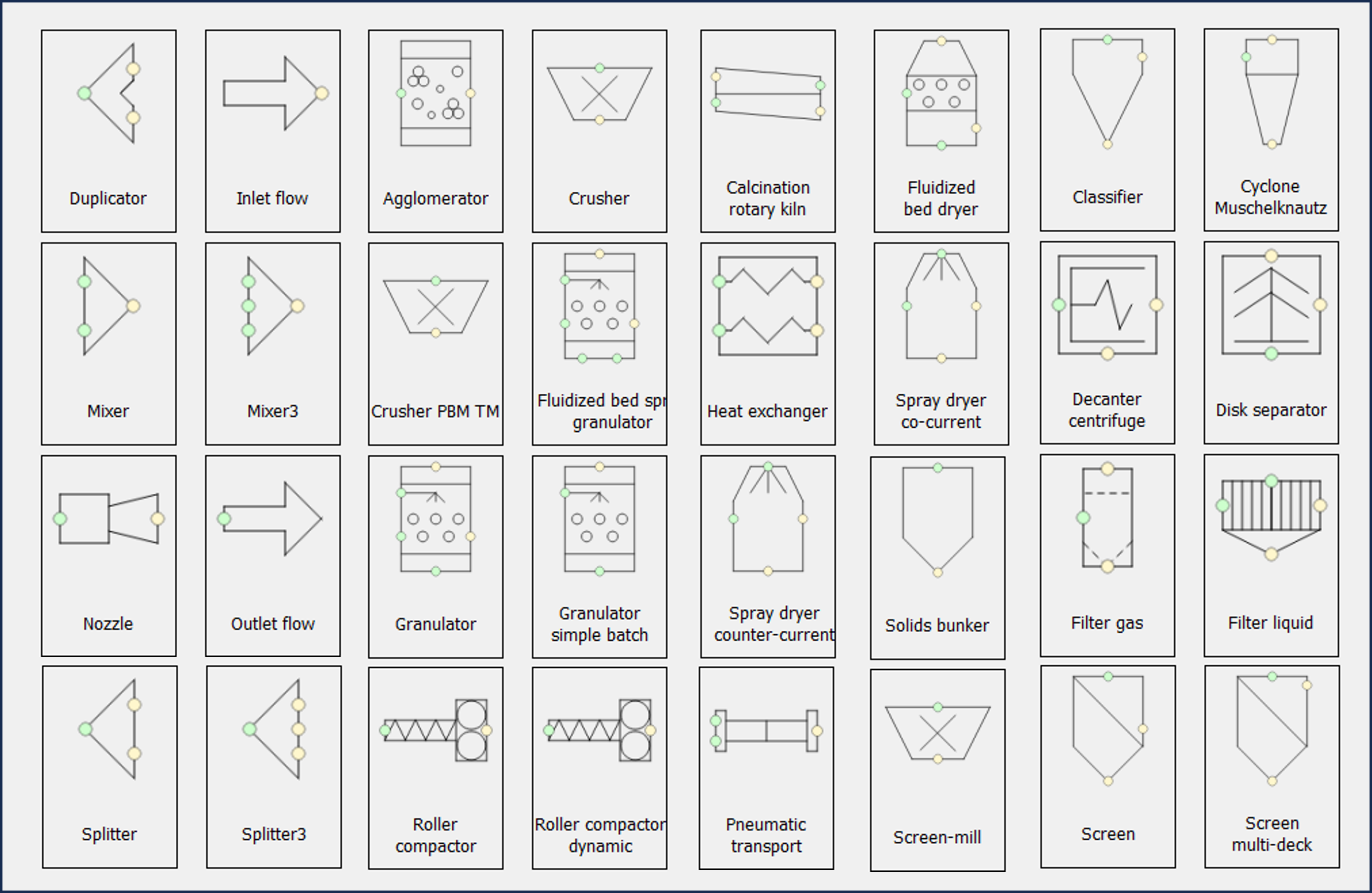
Implemented process units

Ready to use. Proven in research and industry for years.

Implemented units in DyssolPro

Missing a specific unit?

Contact us

Feature demonstrations

Engineering-focused scenarios collected from DyssolPro public sources such as webinars, conference presentations, and technical talks. These examples are intended to help readers quickly assess technical fit for similar solids-processing challenges.

Screening and classification

Screening with coupled multidimensional particle properties

Engineering problem: In solids screening, size-based classification is straightforward, but linked particle attributes (for example color, density, porosity, or other material properties) can be misrepresented in simplified models.

Feature + demo: DyssolPro demonstrates multidimensional distributed properties so screening remains physically consistent while preserving coupled particulate attributes through the flowsheet.

Pharma solids processing

Agglomeration with API distribution and recycle loop behavior

Engineering problem: Pharmaceutical agglomeration requires simultaneous tracking of particle size growth and API concentration while particles pass through screen and mill recycle loops.

Feature + demo: The demonstration shows dynamic solids-process simulation with coupled properties for agglomerator, screen, and mill interaction.

Granulation and fluidized operation

Dynamic granulation instability in screen-mill recycle systems

Engineering problem: Granulation loops with fluidization gas can show unstable transient behavior that steady-state tools do not reveal.

Feature + demo: DyssolPro demonstrates dynamic simulation of startup trajectories, loop oscillations, and recycle-driven instability in fertilizer-like granulation flowsheets.

Sensitivity analysis

Startup-time versus throughput tradeoff identification

Engineering problem: Teams often need to reduce time-to-steady-state without causing unacceptable throughput shifts when varying mill power in recycle-loop operation.

Feature + demo: The built-in sensitivity analysis explores parameter ranges and quantifies how startup time and process performance trade off across operating points.

Optimization and model calibration

Constrained optimization and PSD-based parameter estimation

Engineering problem: Process optimization and model fitting are difficult when objectives, constraints, and measured particle-size-distribution data must be handled together.

Feature + demo: DyssolPro demonstrates integrated non-gradient optimization plus parameter estimation workflows to calibrate simplified models to measured PSD behavior.

Dynamic vs steady-state simulation

Transient startup, shutdown, and process-upset visibility

Engineering problem: Steady-state-only evaluations miss transient events such as startup overshoot, shutdown behavior, and clogging-driven disturbances.

Feature + demo: The demonstration explains why dynamic flowsheet simulation is critical for batch, semi-batch, and continuous solids plants when transient risk matters.

Dyssol application examples

Compact engineering examples showing process scope, Dyssol implementation approach, and practical value for process teams.

Porcelain tile manufacturing: integrated digital-twin and optimization workflow

Project scope: Full wet-route line (milling, spray drying, storage, pressing, drying, firing) with linked quality, productivity, energy, cost, and CO2 targets.

How Dyssol was used: Unit models were calibrated against lab/industrial data and coupled to optimization workflows (including Dyssol-MATLAB loops). Follow-up work expanded the optimization from operating setpoints to raw-material composition ranges, because raw-material variability shifts firing behavior and final quality. This enabled engineers to evaluate recipe and operating parameter combinations across the process chain, not just single best-point settings.

How Dyssol helped: By evaluating recipe and operating parameters together in one dynamic flowsheet, teams identified feasible operating windows that lower fuel demand and emissions while keeping quality constraints (e.g., porosity/water-absorption limits). One reported outcome is up to 30.2% lower fuel demand per ton of fired tile for selected operating conditions.

Practical takeaway: Use a coupled flowsheet when recipe, milling, and kiln settings need to be evaluated together against quality and energy targets.

Sources: 10.1016/j.cirpj.2021.04.011, 10.3390/machines11020137, 10.1016/j.ceramint.2023.01.056, 10.1111/jace.19581

Li-ion battery mechanical recycling: dynamic interaction of comminution and separation

Project scope: Mechanical process chain around cutting mill and zig-zag sifter for secondary battery materials, including transient feed variations.

How Dyssol was used: Unit models for milling and classification were connected as one dynamic flowsheet, so outlet mass/PSD transients from milling propagated directly into separator performance.

How Dyssol helped: By propagating mill transients directly into the separator model, Dyssol made the cause-effect clear: rising upstream mass flow broadens separator cut behavior and reduces separation sharpness, which directly shifts recovery and purity predictions.

Practical takeaway: Model upstream transients explicitly, because separator efficiency and product quality metrics can shift during non-steady operation.

Source: 10.1002/cite.202200156

Industrial zeolite production: multiscale surrogate integration in one flowsheet

Project scope: End-to-end catalyst process with synthesis, decanter washing/concentration, spray drying, and two-stage rotary-kiln calcination.

How Dyssol was used: DEM-informed ANN surrogates and PBM were integrated into the synthesis stage and connected with dynamic downstream unit models in one process-level flowsheet.

How Dyssol helped: By combining surrogate synthesis models with dynamic downstream units in one flowsheet, Dyssol enabled teams to evaluate fast and slow dynamics together while tracking multidimensional solids properties through the full chain.

Practical takeaway: Surrogate-assisted flowsheeting is useful when high-fidelity synthesis behavior is needed without losing process-level simulation speed.

Source: Processes 2022, 10(10), 2140

Continuous vibrated fluidized-bed drying: validated dynamic shortcut model

Project scope: Continuous dryer modeling across multiple geometries and particle classes (Geldart A/B/D), including vibration effects relevant for pharma/food solids.

How Dyssol was used: Implemented coupled hydrodynamics and drying kinetics with distributed particle properties, then validated against broad experimental parameter sweeps.

How Dyssol helped: Because the coupled drying model was validated across broad experiments, teams could use it for fast operating-window comparisons with reported moisture deviations below 14% in key cases and low temperature deviations (often a few percent), at practical runtimes (reported 1-3 min on a standard PC).

Practical takeaway: This type of model is well suited for fast comparison of operating windows across materials, geometries, and vibration settings.

Source: 10.3390/pr9010052

Semi-batch precipitation: mixing-sensitive product formation

Project scope: Semi-batch precipitation of sparingly soluble salts with quality targets that depend on local mixing, supersaturation, and transient feed strategy.

How Dyssol was used: Dynamic precipitation models were implemented as flowsheet units to evaluate operating strategies and mixing-related effects across the process sequence.

How Dyssol helped: By explicitly simulating dynamic feed and mixing strategies, Dyssol enabled teams to quantify trade-offs between product quality and stable operation and to narrow candidate operating windows.

Practical takeaway: For mixing-sensitive precipitation, evaluate time-varying feed and agitation policies directly, not only nominal steady assumptions.

Sources: 10.1016/j.compchemeng.2020.106818, KIT 1000076187

Chemical looping combustion: dynamic coupled-reactor operation

Project scope: Pilot-scale CLC with strongly coupled fluidized-bed units, cyclone, loop seals, and circulating oxygen carrier.

How Dyssol was used: Dynamic flowsheet models were built for reactor hydrodynamics and inter-unit solids/gas coupling, then validated against pilot measurements (including transient load changes).

How Dyssol helped: By reproducing observed transients in bed masses, solids circulation, and pressure/gas trends, Dyssol exposed a key system effect: if redox dynamics are included in methane CLC, the characteristic response shifts from around ~30 s to several hundred seconds, i.e., much slower transient behavior.

Practical takeaway: For load-change studies in coupled reactor systems, include both hydrodynamics and redox-state dynamics in the same dynamic model.

Sources: 10.1016/j.ijggc.2018.03.004, 10.1016/j.powtec.2016.12.022

Request a technical consultation

Discuss your process directly with the DyssolTEC development team.

Request Consultation

Technical FAQ

Answers to common technical evaluation questions from process engineering teams.

Can DyssolPro simulate dynamic process behavior?

Yes. DyssolPro supports time-dependent flowsheet simulation, including startup, shutdown, batch, semi-batch, and continuous operation.

What process units are available out of the box?

Out-of-the-box units cover core solids operations, including inlet and outlet streams, agglomeration and granulation, crushing, classification and cyclones, spray and fluidized-bed drying, calcination rotary kiln, heat exchange, decanter centrifuge and disk separation, gas and liquid filtration, solids storage, splitting and mixing, screening, pneumatic transport, and roller compaction.

Can we implement and validate our own process models?

Yes. The Model Maker in DyssolPro supports implementation, testing, and validation of custom unit models for company-specific processes.

Does DyssolPro include GUI-based flowsheet setup?

Yes. DyssolPro includes a GUI for flowsheet configuration and result analysis, including Drag-and-Drop support for flowsheet design.

Are optimization and sensitivity analysis available?

Yes. DyssolPro includes integrated tools for automated process optimization and sensitivity analysis.

Which platforms are supported?

DyssolPro is available for Windows and Linux, with enterprise support options from DyssolTEC.

How mature is DyssolPro for industrial projects?

DyssolPro is built on 13 years of continuous development in dynamic solids process simulation.

Technical questions about DyssolPro?

Speak directly with our development team. We assess DyssolPro's technical fit for your process.

Request Consultation
Sign up to receive the latest news about
Dyssol and DyssolTEC